Table of contents [Show]
-
1
Devi Bharavi
- 1. 1 What the Name Bhairavi Means
- 1. 2 Queen of Bhairava, Destroyer of the System
- 1. 3 Origin of Goddess Bhairavi
- 1. 4 Her Fierce Appearance
- 1. 5 In the Battlefield
- 1. 6 Bhairavi in Tantra Vidhya
- 1. 7 Aghoris
- 1. 8 Worship of Goddess Bhairavi
- 1. 9 Key Attributes
- 1. 10 Practical / Modern Context
- 1. 11 Common Misconceptions
- 1. 12 Conclusion
- 1. 13 Related Prabhukedwar Guides
Devi Bharavi
Devi Bhairavi (भैरवी), the fifth of the ten Mahavidyas, is the goddess of creation, preservation, and destruction. Her name is rooted in bhaya (fear) and conveys terror — she is the "terrible one" whose very name brings awe to the three worlds. Also known as Tripura Bhairavi, she presides over the three lokas (tri + pura). She governs the ever-revolving cycle in which everything created is eventually dissolved, so that creation itself may continue.
The goddess embodies the qualities of Agni (fire), Vidyut (lightning), and Surya (sun), carrying within her the forces honoured as Indra, Surya, and Agni. She is the goddess of Kundalini, the primal spiritual energy coiled at the base of the spine — which is why her worship almost always involves meditation aimed at awakening Kundalini.
What the Name Bhairavi Means
The inner meaning of Bhairavi points to the cosmic work of creation, care, and destruction. She represents the ever-changing heat of Tapas and the Divine Light of Tejas. Tapas, in this context, is not mere self-denial but a growing inner fire that burns away every selfish attachment. Bhairavi is thus a revolution born of destruction — which is never an evil in her hands — for she ignites the human light and heat that burns away the imperfections of the soul.
She is a child of Shakti, celebrated in Hindu folklore and in Tantric practice as the "heroic goddess." Through her power of divine expression and spiritual fire, she removes every obstacle to the revelation of true consciousness, just as she destroyed the demon Mahishasura.
Queen of Bhairava, Destroyer of the System
Bhairavi is regarded as the queen of Bhairava, the fierce form of Lord Shiva. She is the ever-present goddess who combines the world's destructive elements — yet destruction here is not evil, for nature cannot continue without it. She is called Shubhamkari, the Good Mother to good people, and terrible to those who do evil.
When Bhairavi entered the battlefield, her horrifying appearance so weakened the demons that many panicked at the mere sight of her. In the Durga Saptashati's account of the destruction of the powerful demons Shumbha and Nishumbha, Bhairavi appears chiefly as Goddess Kali. When she slew the demons Chanda and Munda and drank their blood, Goddess Parvati blessed her with the name Chamundeshwari.
Creation and dissolution are the two essential rhythms of the universe. They rule equally, each depending on the other. Bhairavi embodies the goal of dissolution — she is present when the body decays, a natural and unavoidable force. She is also said to manifest in self-harming habits, such as the consumption of tamasic food (associated with ignorance and lust) and intoxicants that debilitate body and mind. Anger, jealousy, and selfish actions strengthen her presence in the world; right conduct, by contrast, weakens her destructive grip. She is thus an eternal goddess who reveals herself through the cycles of decay — and through whose transformed power creation continues anew, as seen even in diet and metabolism, where life is nourished through the burning of what is consumed.
Origin of Goddess Bhairavi
The goddess of destruction is the mistress of Kala Bhairava, the fierce aspect of Shiva, and is hence also known as Kala Bhairavi. Kali is called the first form of power (Adi Shakti), worshipped in ten forms known as the Dasha Mahavidyas, of which Bhairavi is the fifth — which is why she shares so many features with Kali. Devi Bhairavi also praises the great power of speech, empowered by the wrath of blazing fire, the Tejas.
Her Fierce Appearance
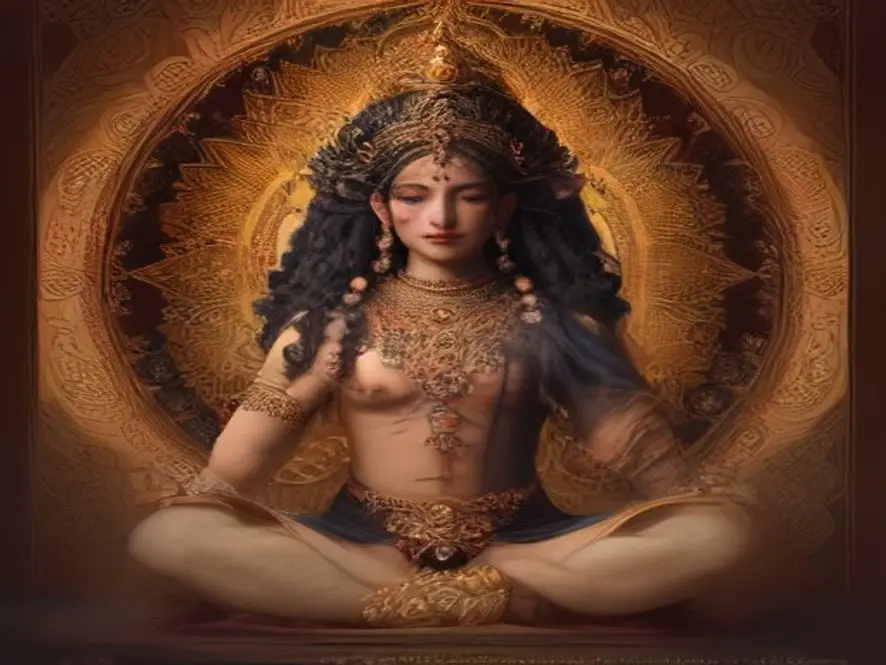
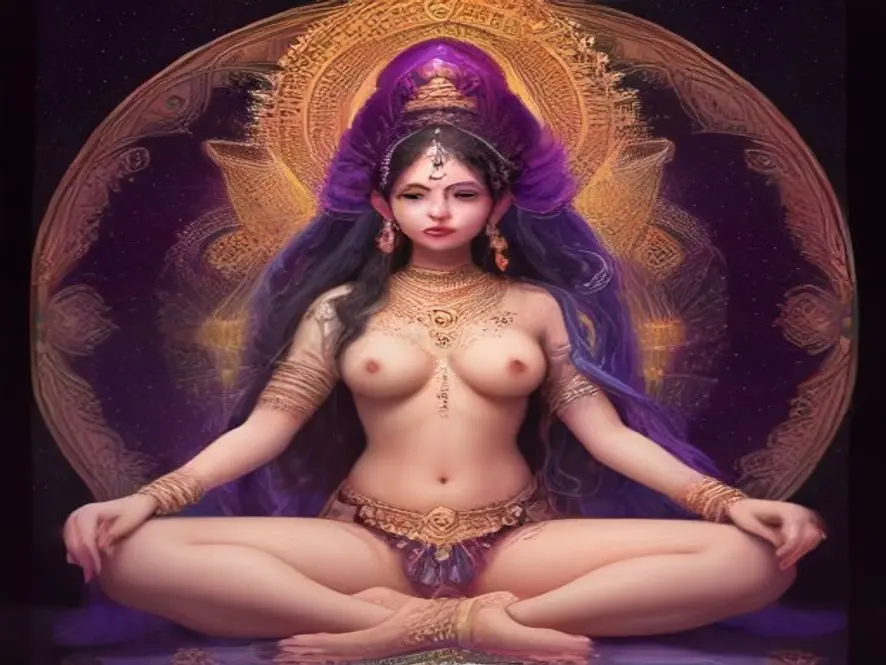
Bhairavi is often portrayed in the cremation ground as a form of sadhana. Unlike other goddesses, her hair is not neatly tied but loose and wild. She wears a red garment adorned with skulls, like Goddess Kali.
- One hand is raised in a gesture that grants fearlessness
- On one side she holds a sword, on the other a severed head
- She has reddish-brown skin, blood smeared on her body
- She carries weapons such as the trident
- She is often seated on a headless body, called Savasadhana, itself a form of meditation
- Her hands show the Abhaya and Varada mudras
- Her vahana is the lion, demonstrating her power on the battlefield
- She is depicted as joyful or in a fierce mood with bared teeth
She dwells in the region of the patala (the netherworld). A calm and composed goddess in meditation, she is in some traditions depicted as a blood-drinking goddess clad in leopard skin and skeletons.
In the Battlefield
One would not wish to face the edge of her anger. Her very appearance made the demons fall to their knees. Bhairavi's presence is symbolic in today's world as well: she is said to be present in all our harmful habits, desires, and thoughts, and she helps us fight them. She also illustrates the power of knowledge.
Bhairavi in Tantra Vidhya
Bhairavi is a form of great cosmic awareness and is considered one of the most powerful Tantric goddesses among the Dasha Mahavidyas. She is a mother who can do almost anything to protect her children.
In Tantra Vidhya she is an immature (unmanifest) form of power, associated with many tantric kriyas such as the Bhairavi Kriya, which combine all forms of light energy, fire, and earth into one. She also holds the power to regulate rebirth and transmigration across the three worlds.
Chatuhsashti Yogini
Chatuhsashti Yogini refers to the 64 Yoginis, a mysterious women's cult of the 9th century whose purpose was to develop supernatural powers. They considered themselves servants of the Divine Mother and were naturally devoted to her. Though linked to the darker stream of Tantra, they were not witches. Their theme of worship was Bhairavi, Kali, and Shiva Bhairava, using the destructive power of Kali or Bhairavi to reach a good conclusion.
An ancient Yogini temple exists at Hirapur, where the chief Yogini is Mahamaya, as described in the Devi Bhagavatam. The difference between Kali and Bhairavi is that Shiva appears far more fierce as Bhairavi's consort than as Kali's companion — recalling that Bhairavi is among the most terrible forms of the Divine Mother.
The Kaula Marga (the Path of Time) points to tantric practices associated with the worship of the goddess. Bhairavi is honoured in her fierce state in a practice known as the Bhairava Chakra, a circle of experience into which yogis of various categories are initiated. This sadhana tradition includes the Pancha Makaras — the five M's: Matsya (fish), Mamsa (meat), Mudra (grain), Madya (wine), and Maithuna (union). The sexual reference in Tantra may be a physical act or a secret inner code, and its understanding is traditionally sought from the guru.
Aghoris
Aghoris pay homage to Bhairava and Bhairavi at the temples of Shiva, and are found near cremation grounds. They stand as the fierce aspects of Shiva and Parvati, represented by a stone with an angry face painted upon it and a wooden trunk painted with three eyes of the goddess. Before their temples are placed three skulls, symbolising Shiva's reign over the three gunas. A female fox serves as the messenger of Smashan Tara ("Tara of the cremation ground"). Behind it burns a lamp made from a human skull, set upon a square block of earth and fuelled with human fat and twisted hair. From its flame rises the symbol of the tantric rod or khatvanga — a small skull set upon a handle of human vertebrae — topped with a fiery metal trident, symbolising the goddess's victory over the three worlds, the past, present, and future, and the three poisons of ignorance, desire, and hatred.
The goddesses are revered as pure love. Bhairavi has her own stringent customs, and those who have not been initiated into Tantra may focus on the gentler goddesses. Yet all goddesses are one; there is a vast difference between the fire of a matchbox and a forest fire.
Worship of Goddess Bhairavi
She is worshipped as the chakra with 64 spokes on the wheel. The worship of the ten Mahavidyas brings immediate blessings, and devotees are blessed with offspring. She helps her worshippers find relief from the pain of loss and bereavement.
A sadhaka who completes the Bhairavi Sadhana acquires all the Ashta Siddhis, leading to spiritual progress and understanding of supernatural powers and techniques. She protects her devotees from all evil influences.
She is a goddess feared by evildoers and beloved by the good. Though frightening, her sole purpose is to continue the cycle of destruction and creation on earth. She is a loving mother to all her children and can go to any lengths to protect her devotees.
Unlike the Trinity — Brahma, Vishnu, and Shiva — who each govern one aspect of the cosmic function (creation, preservation, and destruction), Bhairavi controls all three aspects at once. She is a terrible form of the goddess, but of profound wisdom. She expels the evil forces that try to hinder spiritual growth.
Key Attributes
- Deity: Devi Bhairavi (Tripura Bhairavi), fifth of the Dasha Mahavidyas
- Consort: Lord Shiva in his fierce form as Bhairava (Kala Bhairava)
- Vahana: Lion
- Weapon: Sword, severed head, and trident
- Mantra: The Bhairavi mantra is traditionally received through guru-initiated Tantric sadhana
- Symbol: Skull-adorned red garment; also seen as Chamundeshwari
Practical / Modern Context
Bhairavi's worship has powerful modern applications. Her association with Kundalini makes her central to meditation practice: awakening the serpent power at the base of the spine is increasingly sought by those who practise yoga and inner energy work. Her symbolism of destruction as necessary renewal offers a profound life lesson — we must burn away old habits, attachments, and false identities before new growth is possible.
Her protective aspect is invoked when facing deep fear, grief, or difficult transitions. Many devotees recite the Bhairavi Stotram (from the Tantra Sara) or worship her with a 64-spoke yantra to seek courage, mental clarity, and freedom from negative influences and harmful tendencies.
Common Misconceptions
- Bhairavi is a purely "dark" or malevolent goddess — Her destructive power is a natural, necessary force. She is Shubhamkari, the Good Mother, who destroys only impurity, ego, and evil so that creation can continue.
- Tantra worship of Bhairavi involves physical excess — The Pancha Makaras are often symbolic; Maithuna and the other "M's" are codes whose true inner meaning is learned from a qualified guru. Misreading them literally is a serious misunderstanding.
- The 64 Yoginis were witches practising black magic — They were a devotional cult of women devoted to the Divine Mother, using the fierce power of Kali and Bhairavi for auspicious ends. Their goddesses are worshipped even today at temples such as Hirapur.
Conclusion
Devi Bhairavi, the fifth Mahavidya, is the fierce face of the Divine Mother — a goddess of fire, speech, and Kundalini who guards the sacred cycle of creation and destruction. Fearsome to the unrighteous and loving to her children, she remains one of the most powerful deities of Tantra Vidhya. Her worship offers courage, supernatural attainments, and liberation from all evil influences, reminding us that destruction, when wielded by the Mother, is simply the clearing of the ground for new life.
- Complete Guide to Chanting Gayatri Mantra
- Kashi Vishwanath Temple & Sacred Banaras
- Meaning of Om Namah Shivaya Mantra
For more authentic Hindu temple guides, pilgrimage routes, mantras, and Vedic insights, visit Prabhukedwar.